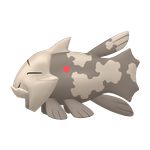
Relicanth ジーランス
Acqua
Roccia
Generation III
Pokémon Longevità
Altezza 1.0m Peso 23.4kg
Nuotovelox
Testadura
Vigore (Abilità nascosta)
Profilo del Pokémon
RELICANTH is a Pokémon species that existed for a hundred million years without ever changing its form. This ancient Pokémon feeds on microscopic organisms with its toothless mouth.
Statistiche base
Statistiche base della forma:Relicanth · Totale 485
PS
100
Attacco
90
Difesa
130
Att. Spec.
45
Dif. Spec.
65
Velocità
55
Informazioni base
- Rapporto di genere
- ♂ 87.5% / ♀ 12.5%
- Tasso di cattura
- 25(3.3%)
- Gruppi uova
- Acqua 1 / Acqua 2
- Cicli di schiusa
- 40
- Amicizia base
- 50
- EV conferiti
- PS+1、Difesa+1
- Esperienza base
- 170
- Forma del corpo
- Pisciforme
- Colore
- Grigio
- Esperienza
- 1,250,000(Lento)
Vantaggi di tipo Vedi la tabella completa dei tipi →
Difensivo (quando si subisce)
Debolezza ×4
Erba ×4
Debolezza ×2
Elettro ×2
Lotta ×2
Terra ×2
Resistenza 1/4
Fuoco ×0.25
Resistenza 1/2
Normale ×0.5
Ghiaccio ×0.5
Veleno ×0.5
Volante ×0.5
Offensivo (quando si attacca)
Debolezza ×2
Fuoco ×2
Ghiaccio ×2
Terra ×2
Volante ×2
Coleottero ×2
Roccia ×2
Catena evolutiva
 Relicanth
Mosse apprendibili
| Livello | Mosse | Tipo | Categoria | Potenza | Precisione | PP |
|---|---|---|---|---|---|---|
| — | Azione | Normale | Fisico | 40 | 100 | 35 |
| — | Rafforzatore | Normale | Stato | — | — | 30 |
| 5 | Pistolacqua | Acqua | Speciale | 40 | 100 | 25 |
| 10 | Forzantica | Roccia | Speciale | 60 | 100 | 5 |
| 15 | Sbadiglio | Normale | Stato | — | — | 10 |
| 20 | Sub | Acqua | Fisico | 80 | 100 | 10 |
| 25 | Riduttore | Normale | Fisico | 90 | 85 | 20 |
| 30 | Idrondata | Acqua | Fisico | 90 | 90 | 10 |
| 35 | Riposo | Psico | Stato | — | — | 10 |
| 40 | Flagello | Normale | Fisico | — | 100 | 15 |
| 45 | Idropompa | Acqua | Speciale | 110 | 80 | 5 |
| 50 | Sdoppiatore | Normale | Fisico | 120 | 100 | 15 |
| 55 | Zuccata | Roccia | Fisico | 150 | 80 | 5 |
| MT | Mosse | Tipo | Categoria | Potenza | Precisione | PP |
|---|---|---|---|---|---|---|
| 招式学习器08 | Iper Raggio | Normale | Speciale | 150 | 90 | 5 |
| 招式学习器09 | Gigaimpatto | Normale | Fisico | 150 | 90 | 5 |
| 招式学习器19 | Salvaguardia | Normale | Stato | — | — | 25 |
| 招式学习器21 | Riposo | Psico | Stato | — | — | 10 |
| 招式学习器22 | Frana | Roccia | Fisico | 75 | 90 | 10 |
| 招式学习器24 | Russare | Normale | Speciale | 50 | 100 | 15 |
| 招式学习器25 | Protezione | Normale | Stato | — | — | 10 |
| 招式学习器27 | Ventogelato | Ghiaccio | Speciale | 55 | 95 | 15 |
| 招式学习器31 | Attrazione | Normale | Stato | — | 100 | 15 |
| 招式学习器32 | Terrempesta | Roccia | Stato | — | — | 10 |
| 招式学习器33 | Pioggiadanza | Acqua | Stato | — | — | 5 |
| 招式学习器35 | Grandine | Ghiaccio | Stato | — | — | 10 |
| 招式学习器36 | Mulinello | Acqua | Speciale | 35 | 85 | 15 |
| 招式学习器39 | Facciata | Normale | Fisico | 70 | 100 | 20 |
| 招式学习器45 | Sub | Acqua | Fisico | 80 | 100 | 10 |
| 招式学习器48 | Rocciotomba | Roccia | Fisico | 60 | 95 | 15 |
| 招式学习器52 | Rimbalzo | Volante | Fisico | 85 | 85 | 5 |
| 招式学习器53 | Colpodifango | Terra | Speciale | 55 | 95 | 15 |
| 招式学习器54 | Cadutamassi | Roccia | Fisico | 25 | 90 | 10 |
| 招式学习器55 | Acquadisale | Acqua | Speciale | 65 | 100 | 10 |
| 招式学习器76 | Coro | Normale | Speciale | 60 | 100 | 15 |
| 招式学习器81 | Battiterra | Terra | Fisico | 60 | 100 | 20 |
| 招式学习器98 | Battipiedi | Terra | Fisico | 75 | 100 | 10 |
| 招式记录01 | Corposcontro | Normale | Fisico | 85 | 100 | 15 |
| 招式记录03 | Idropompa | Acqua | Speciale | 110 | 80 | 5 |
| 招式记录04 | Surf | Acqua | Speciale | 90 | 100 | 15 |
| 招式记录05 | Geloraggio | Ghiaccio | Speciale | 90 | 100 | 10 |
| 招式记录06 | Bora | Ghiaccio | Speciale | 110 | 70 | 5 |
| 招式记录10 | Terremoto | Terra | Fisico | 100 | 100 | 10 |
| 招式记录16 | Cascata | Acqua | Fisico | 80 | 100 | 15 |
| 招式记录17 | Amnesia | Psico | Stato | — | — | 20 |
| 招式记录20 | Sostituto | Normale | Stato | — | — | 10 |
| 招式记录26 | Resistenza | Normale | Stato | — | — | 10 |
| 招式记录27 | Sonnolalia | Normale | Stato | — | — | 10 |
| 招式记录45 | Fanghiglia | Acqua | Speciale | 90 | 85 | 10 |
| 招式记录46 | Ferroscudo | Acciaio | Stato | — | — | 15 |
| 招式记录49 | Calmamente | Psico | Stato | — | — | 20 |
| 招式记录67 | Geoforza | Terra | Speciale | 90 | 100 | 10 |
| 招式记录69 | Cozzata Zen | Psico | Fisico | 80 | 90 | 15 |
| 招式记录75 | Pietrataglio | Roccia | Fisico | 100 | 80 | 5 |
| 招式记录76 | Levitoroccia | Roccia | Stato | — | — | 20 |
| 招式记录84 | Idrovampata | Acqua | Speciale | 80 | 100 | 15 |
| 招式记录98 | Idrobreccia | Acqua | Fisico | 85 | 100 | 10 |
| 招式记录99 | Schiacciacorpo | Lotta | Fisico | 80 | 100 | 10 |
Moveset competitivi e set di Relicanth
I moveset di Relicanth coprono 6 generazioni e 13 formati con 24 set in totale, inclusi mosse, abilità, oggetti, nature, EV e tipi Teracristal con analisi.
6 Generazione
13 Formato
24 set
Vedi tutti i moveset
Voci del Pokédex
Generation III
- Ruby:
- RELICANTH is a Pokémon species that existed for a hundred million years without ever changing its form. This ancient Pokémon feeds on microscopic organisms with its toothless mouth.
- Sapphire:
- RELICANTH is a rare species that was discovered in deep-sea explorations. This Pokémon’s body withstands the enormous water pressure of the ocean depths. Its body is covered in tough scales that are like craggy rocks.
- Emerald:
- A Pokémon that was once believed to have been extinct. The species has not changed its form for 100 million years. It walks on the seafloor using its pectoral fins.
- FireRed:
- It has remained unchanged for 100 million years. It was discovered during a deep-sea exploration.
Generation IV
- Diamond:
- A rare Pokémon discovered during a deep-sea exploration. It has not changed in over 100 million years.
- HeartGold:
- Discovered by chance during deep-sea explorations, it has not changed since ancient times.
Generation V
- Black:
- A rare Pokémon discovered during a deep-sea exploration. It has not changed in over 100 million years.
Generation VI
- X:
- It has remained unchanged for 100 million years. It was discovered during a deep-sea exploration.
- Y:
- A rare Pokémon discovered during a deep-sea exploration. It has not changed in over 100 million years.
- Omega Ruby:
- Relicanth is a Pokémon species that existed for a hundred million years without ever changing its form. This ancient Pokémon feeds on microscopic organisms with its toothless mouth.
- Alpha Sapphire:
- Relicanth is a rare species that was discovered in deep-sea explorations. This Pokémon’s body withstands the enormous water pressure of the ocean depths. Its body is covered in tough scales that are like craggy rocks.
Generation VII
- Sun:
- Its form has remained the same for one hundred million years. Its body is filled with fat, so it can withstand the water pressure of the deep sea.
- Moon:
- It was fortuitously discovered during a deep sea expedition. Its teeth have atrophied, so it now survives on microscopic organisms it sucks up.
- Ultra Sun:
- Thought to have gone extinct, Relicanth was given a name that is a variation of the name of the person who discovered it.
- Ultra Moon:
- The reason it hasn’t changed at all in a hundred million years is that it’s apparently already a perfect life-form.
Generation VIII
- Sword:
- Rock-hard scales and oil-filled swim bladders allow this Pokémon to survive the intense water pressure of the deep sea.
- Shield:
- This Pokémon was discovered during deep-sea exploration. Its appearance hasn’t changed in 100,000,000 years, so it’s called a living fossil.