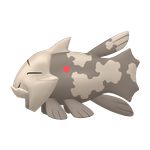
Relicanth ジーランス
Agua
Roca
Generación III
Pokémon Longevo
Altura 1.0m Peso 23.4kg
Nado Rápido
Cabeza Roca
Robustez (Habilidad oculta)
Perfil del Pokémon
RELICANTH is a Pokémon species that existed for a hundred million years without ever changing its form. This ancient Pokémon feeds on microscopic organisms with its toothless mouth.
Estadísticas base
Estadísticas base de la forma:Relicanth · Total 485
PS
100
Ataque
90
Defensa
130
At. Esp.
45
Def. Esp.
65
Velocidad
55
Información básica
- Proporción de género
- ♂ 87.5% / ♀ 12.5%
- Tasa de captura
- 25(3.3%)
- Grupos huevo
- Agua 1 / Agua 2
- Ciclos de eclosión
- 40
- Amistad base
- 50
- EV que otorga
- PS+1、Defensa+1
- Experiencia base
- 170
- Forma del cuerpo
- Pisciforme
- Color
- Gris
- Experiencia
- 1,250,000(Lento)
Ventajas de tipos Ver la tabla completa de tipos →
Defensivo (al ser atacado)
Debilidad ×4
Planta ×4
Debilidad ×2
Eléctrico ×2
Lucha ×2
Tierra ×2
Resistencia 1/4
Fuego ×0.25
Resistencia 1/2
Normal ×0.5
Hielo ×0.5
Veneno ×0.5
Volador ×0.5
Cadena evolutiva
 Relicanth
Movimientos aprendibles
| Nivel | Movimientos | Tipo | Categoría | Potencia | Precisión | PP |
|---|---|---|---|---|---|---|
| — | Placaje | Normal | Físico | 40 | 100 | 35 |
| — | Fortaleza | Normal | Estado | — | — | 30 |
| 5 | Pistola Agua | Agua | Especial | 40 | 100 | 25 |
| 10 | Poder Pasado | Roca | Especial | 60 | 100 | 5 |
| 15 | Bostezo | Normal | Estado | — | — | 10 |
| 20 | Buceo | Agua | Físico | 80 | 100 | 10 |
| 25 | Derribo | Normal | Físico | 90 | 85 | 20 |
| 30 | Acua Cola | Agua | Físico | 90 | 90 | 10 |
| 35 | Descanso | Psíquico | Estado | — | — | 10 |
| 40 | Azote | Normal | Físico | — | 100 | 15 |
| 45 | Hidrobomba | Agua | Especial | 110 | 80 | 5 |
| 50 | Doble Filo | Normal | Físico | 120 | 100 | 15 |
| 55 | Testarazo | Roca | Físico | 150 | 80 | 5 |
| MT | Movimientos | Tipo | Categoría | Potencia | Precisión | PP |
|---|---|---|---|---|---|---|
| 招式学习器08 | Hiperrayo | Normal | Especial | 150 | 90 | 5 |
| 招式学习器09 | Gigaimpacto | Normal | Físico | 150 | 90 | 5 |
| 招式学习器19 | Velo Sagrado | Normal | Estado | — | — | 25 |
| 招式学习器21 | Descanso | Psíquico | Estado | — | — | 10 |
| 招式学习器22 | Avalancha | Roca | Físico | 75 | 90 | 10 |
| 招式学习器24 | Ronquido | Normal | Especial | 50 | 100 | 15 |
| 招式学习器25 | Protección | Normal | Estado | — | — | 10 |
| 招式学习器27 | Viento Hielo | Hielo | Especial | 55 | 95 | 15 |
| 招式学习器31 | Atracción | Normal | Estado | — | 100 | 15 |
| 招式学习器32 | Tormenta Arena | Roca | Estado | — | — | 10 |
| 招式学习器33 | Danza Lluvia | Agua | Estado | — | — | 5 |
| 招式学习器35 | Granizo | Hielo | Estado | — | — | 10 |
| 招式学习器36 | Torbellino | Agua | Especial | 35 | 85 | 15 |
| 招式学习器39 | Imagen | Normal | Físico | 70 | 100 | 20 |
| 招式学习器45 | Buceo | Agua | Físico | 80 | 100 | 10 |
| 招式学习器48 | Tumba Rocas | Roca | Físico | 60 | 95 | 15 |
| 招式学习器52 | Bote | Volador | Físico | 85 | 85 | 5 |
| 招式学习器53 | Disparo Lodo | Tierra | Especial | 55 | 95 | 15 |
| 招式学习器54 | Pedrada | Roca | Físico | 25 | 90 | 10 |
| 招式学习器55 | Salmuera | Agua | Especial | 65 | 100 | 10 |
| 招式学习器76 | Canon | Normal | Especial | 60 | 100 | 15 |
| 招式学习器81 | Terratemblor | Tierra | Físico | 60 | 100 | 20 |
| 招式学习器98 | Pataleta | Tierra | Físico | 75 | 100 | 10 |
| 招式记录01 | Golpe Cuerpo | Normal | Físico | 85 | 100 | 15 |
| 招式记录03 | Hidrobomba | Agua | Especial | 110 | 80 | 5 |
| 招式记录04 | Surf | Agua | Especial | 90 | 100 | 15 |
| 招式记录05 | Rayo Hielo | Hielo | Especial | 90 | 100 | 10 |
| 招式记录06 | Ventisca | Hielo | Especial | 110 | 70 | 5 |
| 招式记录10 | Terremoto | Tierra | Físico | 100 | 100 | 10 |
| 招式记录16 | Cascada | Agua | Físico | 80 | 100 | 15 |
| 招式记录17 | Amnesia | Psíquico | Estado | — | — | 20 |
| 招式记录20 | Sustituto | Normal | Estado | — | — | 10 |
| 招式记录26 | Aguante | Normal | Estado | — | — | 10 |
| 招式记录27 | Sonámbulo | Normal | Estado | — | — | 10 |
| 招式记录45 | Agua Lodosa | Agua | Especial | 90 | 85 | 10 |
| 招式记录46 | Defensa Férrea | Acero | Estado | — | — | 15 |
| 招式记录49 | Paz Mental | Psíquico | Estado | — | — | 20 |
| 招式记录67 | Tierra Viva | Tierra | Especial | 90 | 100 | 10 |
| 招式记录69 | Cabezazo Zen | Psíquico | Físico | 80 | 90 | 15 |
| 招式记录75 | Roca Afilada | Roca | Físico | 100 | 80 | 5 |
| 招式记录76 | Trampa Rocas | Roca | Estado | — | — | 20 |
| 招式记录84 | Escaldar | Agua | Especial | 80 | 100 | 15 |
| 招式记录98 | Hidroariete | Agua | Físico | 85 | 100 | 10 |
| 招式记录99 | Plancha Corporal | Lucha | Físico | 80 | 100 | 10 |
Movimientos competitivos y sets de Relicanth
Los movimientos de Relicanth cubren 6 generaciones y 13 formatos con 24 sets en total, incluyendo movimientos, habilidades, objetos, naturalezas, EVs y tipos Tera con análisis.
6 Generación
13 Formato
24 set
Ver todos los movimientos
Entradas del Pokédex
Generation III
- Ruby:
- RELICANTH is a Pokémon species that existed for a hundred million years without ever changing its form. This ancient Pokémon feeds on microscopic organisms with its toothless mouth.
- Sapphire:
- RELICANTH is a rare species that was discovered in deep-sea explorations. This Pokémon’s body withstands the enormous water pressure of the ocean depths. Its body is covered in tough scales that are like craggy rocks.
- Emerald:
- A Pokémon that was once believed to have been extinct. The species has not changed its form for 100 million years. It walks on the seafloor using its pectoral fins.
- FireRed:
- It has remained unchanged for 100 million years. It was discovered during a deep-sea exploration.
Generation IV
- Diamond:
- A rare Pokémon discovered during a deep-sea exploration. It has not changed in over 100 million years.
- HeartGold:
- Discovered by chance during deep-sea explorations, it has not changed since ancient times.
Generation V
- Black:
- A rare Pokémon discovered during a deep-sea exploration. It has not changed in over 100 million years.
Generation VI
- X:
- It has remained unchanged for 100 million years. It was discovered during a deep-sea exploration.
- Y:
- A rare Pokémon discovered during a deep-sea exploration. It has not changed in over 100 million years.
- Omega Ruby:
- Relicanth is a Pokémon species that existed for a hundred million years without ever changing its form. This ancient Pokémon feeds on microscopic organisms with its toothless mouth.
- Alpha Sapphire:
- Relicanth is a rare species that was discovered in deep-sea explorations. This Pokémon’s body withstands the enormous water pressure of the ocean depths. Its body is covered in tough scales that are like craggy rocks.
Generation VII
- Sun:
- Its form has remained the same for one hundred million years. Its body is filled with fat, so it can withstand the water pressure of the deep sea.
- Moon:
- It was fortuitously discovered during a deep sea expedition. Its teeth have atrophied, so it now survives on microscopic organisms it sucks up.
- Ultra Sun:
- Thought to have gone extinct, Relicanth was given a name that is a variation of the name of the person who discovered it.
- Ultra Moon:
- The reason it hasn’t changed at all in a hundred million years is that it’s apparently already a perfect life-form.
Generation VIII
- Sword:
- Rock-hard scales and oil-filled swim bladders allow this Pokémon to survive the intense water pressure of the deep sea.
- Shield:
- This Pokémon was discovered during deep-sea exploration. Its appearance hasn’t changed in 100,000,000 years, so it’s called a living fossil.